
•
Blog

In home services, trust is everything. Before a customer ever calls you, they’re looking for proof that you’re reliable, professional, and worth inviting into their home. And more often than not, that proof comes from your Google reviews.
That’s where Google reviews come in.
For most homeowners, reviews are the first checkpoint in that decision-making process. They’re reading about real experiences, looking for proof that you show up on time, do quality work, and treat customers with respect. In 2026, reviews play an even bigger role. Google uses them to determine who shows up in local search results, and AI-powered summaries pull directly from customer feedback to highlight what your business is known for. That means your reviews don’t just influence whether a customer chooses you, they influence whether they see you in the first place.
The challenge is that most home service businesses don’t have a consistent way to generate reviews. Requests are sent occasionally, follow-ups are missed, and results vary from job to job.
The good news is that getting more Google reviews isn’t about working harder or constantly reminding your team to ask. It’s about building a simple, repeatable system that turns every completed job into an opportunity for feedback.
In this guide, we’ll break down exactly how to do that so you can build trust faster, show up more often in search, and turn more jobs into 5-star reviews.
Why Google Reviews Matter More Than Ever in 2026
In home services, most customers aren’t doing extensive research across multiple pages of results. If someone searches for “painting company near me” or “emergency plumber,” they typically focus on the first few options that appear. They’re not scrolling to page two or three of Google or comparing dozens of businesses.
In practice, most people:
-
Look at the top results on the page
-
Click one of the businesses in the local pack
-
Or choose based on what stands out immediately
If your business isn’t visible early in that process, you’re far less likely to be considered.
In 2026, Google now uses reviews to determine who shows up in local search results, and AI-powered summaries pull directly from customer feedback to help people choose a business faster. That means your reviews aren’t just influencing potential customers, they’re influencing how visible your business is in the first place.
Local Pack
With Google’s new updates, reviews now account for 20% of local pack ranking. That’s a significant portion, especially in competitive home service markets where multiple businesses offer the same service at similar price points. In those cases, reviews often become the deciding factor of how your business ranks on Google and how visible you are to customers.
To understand why this matters, let’s look at what the local pack actually is. When someone searches for something like “plumber near me” or “HVAC repair in Toronto”, the first thing they see (right below the ad section) is a map with three business listings. That section is called the local pack, which includes:
-
A map showing nearby businesses
-
Three highlighted listings
-
Star ratings, reviews counts and key details
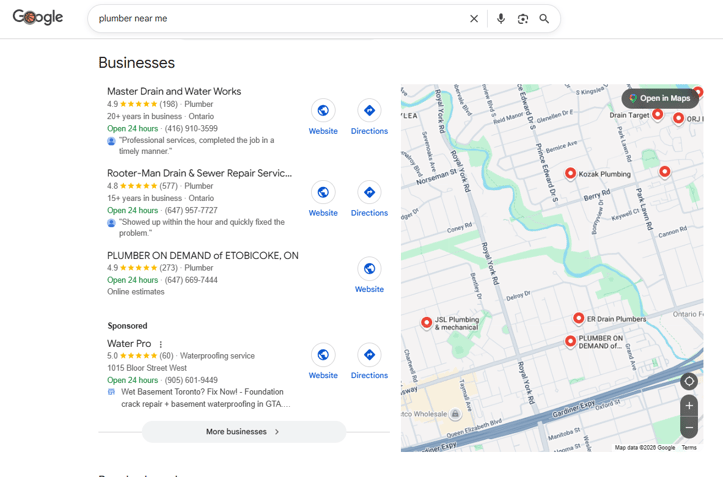
This section is prime real estate on Google. Businesses that appear here get the majority of clicks and calls.
If two plumbing companies are competing for one of those three spots, and one company has 35 reviews with a 4.3 star average while the other has 120 reviews with a 4.8 star average and recent reviews—Google is far more likely to prioritize the second business. Not just because of the higher rating, but because of the volume, recency, and content of those reviews that signal that the business is active, trusted and relevant.
AI-Powered Overviews
Another important part of your visibility to customers is how Google presents your business in AI overviews.
With Google’s AI overview feature, your reviews are being used to inform Google and then being summarized for potential customers.
When someone searches for a service, they’re increasingly shown AI-generated summaries at the very top of the page. These summaries pull directly from customer reviews to highlight what your business is known for.
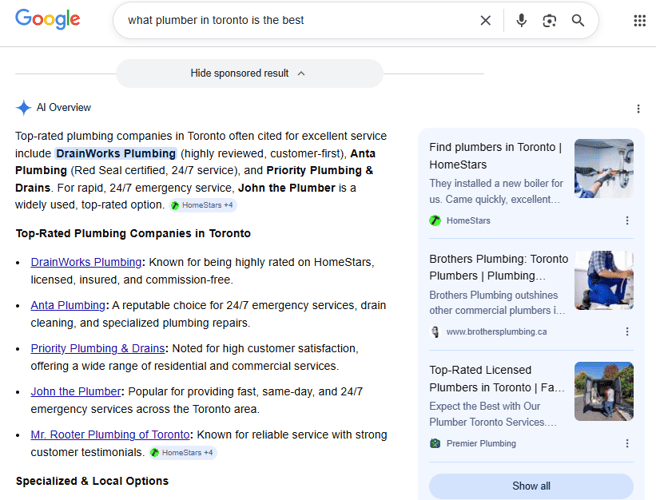
Instead of clicking through multiple websites to inform their decision, users are now getting answers instantly. In fact, AI overviews appear on up to 30-48% of searches and when they do, organic click-through rates can drop by 34-61%. That means a large portion of users never click into websites at all, they make their decisions based on what Google shows them upfront.
So what does this mean for your business? AI-powered summaries are designed to help customers make faster decisions. Instead of comparing multiple businesses manually, they’re relying on Google to surface the best options.
Those summaries often include insights like:
-
“Known for fast response time”
-
“Customers mention clear communication and fair pricing”
-
“Highly rated for professionalism”
All of those insights come directly from your reviews. If your review profile is active, detailed and consistent, Google has more content to pull from and your business is more likely to be featured.
The Importance of Following Up
The biggest mistake that most contractors make is assuming that if a customer doesn’t leave a review after the first request, they’re just not interested in leaving a review. In reality, that’s rarely the trust. They might have seen the message while they were busy, planned to come back to it later and forgot. That’s why relying on a single request limits how many reviews you generate.
When you send a second message a couple of days later, you:
-
Bring the request back to their attention
-
Give them another opportunity to act
-
Capture reviews from customers who simply missed the first ask
In many cases, that one follow-up can significantly increase your total review volume. When you extend this further by adding a second and third follow-up, the impact compounds. Each additional touchpoint gives customers another chance to respond at a time that works for them. Instead of relying on a single moment, you’re creating multiple opportunities for action. The result is a noticeable lift in reviews.
The 5-Step Review Request System That Actually Works
Step 1: Ask within 24 hours of job completion
Timing has a direct impact on both how many reviews you get and how detailed those reviews are.
Right after a job is completed:
-
The customer still remembers the interaction clearly
-
The outcome of the job is top of mind
-
The emotional response such as relief, satisfaction, or appreciation, is still strong
This is when customers are most likely to leave a review, and more importantly, to leave a specific and descriptive one. Instead of a generic “great service,” you’re more likely to get mentions of the technician, the issue that was fixed, and how quickly it was resolved.
Step 2: Use SMS, not just email
Emails can be easy to miss. Messages can end up in spam folders, buried in inboxes, or filtered into promotions tabs. Even if they’re opened, they’re often not acted on right away. On the other hand, SMS is more direct.
Text messages:
-
Are typically seen within minutes
-
Don’t rely on inbox filtering
-
Feel more personal and immediate
That visibility leads to higher response rates. That’s why a strong system doesn’t rely on just one channel. NiceJob’s automated review campaigns combine both SMS and email for maximum efficiency.
Step 3: Send a direct review link (not your GBP homepage)
Even small amounts of friction can prevent a customer from leaving a review. If a customer has to navigate through multiple websites or pages in order to leave a review, chances are they probably won’t.
Sending a direct link that opens the review form immediately removes any unnecessary steps and makes it as easy as possible for the customer to follow through. The easier the process, the more reviews you’ll get.
Get your direct Google review link in seconds
Use our review link generator to create your direct Google review link and start getting more responses today
Generate Your Link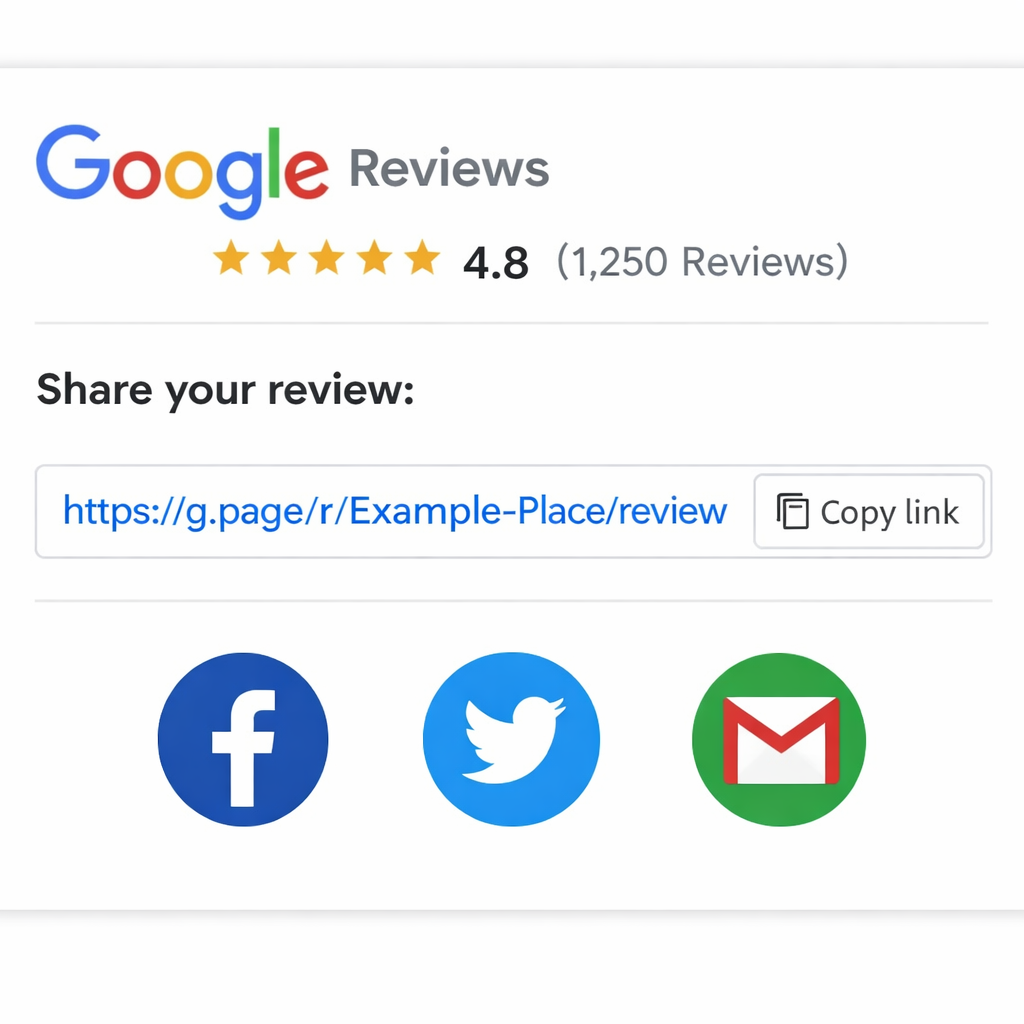
Step 4: Follow up once (then twice, then a final time)
As we mentioned previously, most customers who don’t respond the first time aren’t saying no—they just haven’t gotten around to it yet. Following up gives them another opportunity to act.
A structured follow-up sequence, consisting of both SMS and email reminders, could include:
-
A first request sent out within 24 hours of completing the job
-
Follow-up couple days later
-
Second follow-up if there’s still no response
-
Final reminder to close the loop
Each message increases the likelihood that the customer sees the request at the right moment. When this is done consistently, the impact adds up.
Step 5: Automate the whole thing
Individually, each of these steps is simple. Together, they’re difficult to manage manually.
To execute this system consistently, you would need to:
-
Track every completed job
-
Send requests at the right time
-
Monitor responses
-
Schedule and send multiple follow-ups
Doing that across dozens or hundreds of customers isn’t realistic without a system in place. That’s where review generation for home services becomes scalable through automation.
With automation:
-
Every job triggers a review request automatically
-
Follow-ups are sent on a set schedule
-
No customers are missed
-
The process runs the same way every time
Instead of relying on memory or manual effort, you’re building a system that works in the background.
Real-Life Example: How Miller’s Tree Service Scaled Reviews by 690%
To see how this plays out in practice, let’s take a look at NiceJob client, Miller's Tree Service.
Instead of relying on a single request, they set up NiceJob's 4-step automated follow-up sequence consisting of:
-
Initial SMS request
-
Follow-up email
-
Second SMS reminder
-
Final email reminder
Each step was timed and triggered automatically after a job was completed, removing the need for manual tracking or outreach.
The impact of adding structured follow-ups was significant:
-
They grew from 151 reviews to 1,042+
-
That’s a 690% increase in Google reviews in under two years
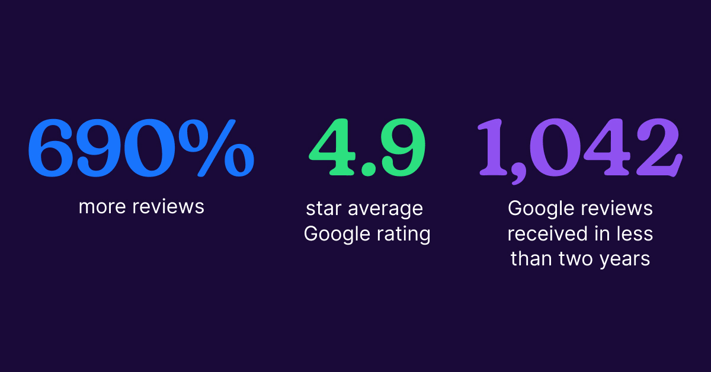
But what’s more important is where those reviews came from. Over 50% of their total reviews came from follow-ups alone—meaning those customers didn’t leave a review after the first request.
Breaking it down further:
-
The first request generated a large portion of reviews
-
The second and third follow-ups added hundreds more
-
Even the final reminder continued to drive additional responses
In total, 523 reviews were generated from follow-up messages that would have otherwise been missed.
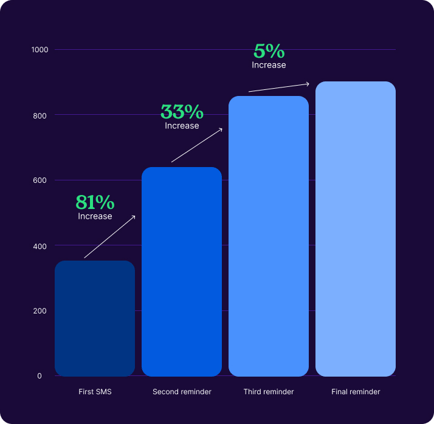
This case study highlights a key takeaway: most customers aren’t declining to leave a review, they just don’t act on the first request. Automation ensures those missed opportunities are followed up on, so fewer reviews slip through the cracks.
Get 4x more reviews by automating your process
Start your free trial today and see how automation can skyrocket your review growth
Start Free
Industry-Specific Tips For Getting More Reviews
The core system for generating reviews stays the same, but how you ask should reflect the context of the job. Different home service industries create different customer experiences. If your request aligns with that moment, it feels more natural and gets better results.
HVAC
HVAC jobs are often tied to comfort—restoring heat in the winter or cooling in the summer.
That moment right after the job is complete is when the impact is most noticeable. The house is comfortable again, and the customer feels immediate relief.
When asking for a review:
-
Reference the problem you solved (no heat, broken AC, poor airflow)
-
Highlight speed and reliability
-
Keep the request tied to the outcome
This helps guide customers toward leaving more specific, useful feedback.
👉Read our full blog getting more reviews for HVAC businesses to learn more.
Plumbing
Plumbing issues are usually urgent and disruptive. Whether it’s a leak, clog, or backup, customers want the problem fixed quickly. Once it’s resolved, there’s a clear shift from stress to relief. That makes timing critical.
Ask for a review immediately after the fix, and frame it around:
-
How quickly the issue was handled
-
The professionalism of the technician
-
The overall experience from problem to solution
Because the situation was urgent, customers are often more motivated to share their experience.
👉 Read our full blog on getting more reviews for plumbing business for more tips and tricks .
Landscaping
Landscaping is highly visual, which makes it one of the easiest industries to generate detailed reviews. Customers can see the results right away whether it’s a clean-up, redesign, or full transformation. The best time to ask is when the job is freshly completed and the visual impact is strongest.
Encourage customers to mention:
-
The before-and-after difference
-
Attention to detail
-
Overall appearance of the space
You can even pair your request with photos, which reinforces the experience and increases engagement.
👉 Read our full blog where we go into detail about how to get more reviews for your landscaping business.
Roofing
Roofing projects are larger investments and often involve longer timelines. Because of that, trust and communication play a bigger role in the customer experience. The ideal moment to ask for a review is after the final walkthrough, when the job is complete and expectations have been confirmed.
Focus your request on:
-
Communication throughout the project
-
Transparency and professionalism
-
Quality of workmanship
Customers in this category are more likely to leave detailed reviews when they feel confident in both the process and the result.
👉Read our full blog to learn more about getting more reviews for your roofing business.
FAQ
How many Google reviews do I need?
There’s no fixed number but what matters is how you compare to competitors in your area.
In most home service markets:
-
If similar businesses have 30–50 reviews, that’s your baseline
-
If top competitors have 100+, that’s what you’re competing against
Instead of aiming for a specific number, focus on:
-
Consistency (getting new reviews every week)
-
Recency (recent reviews carry more weight)
-
Quality (detailed, relevant feedback)
A steady flow of reviews over time is more valuable than a large number all at once.
Can I ask customers for reviews via text?
Yes and it’s one of the most effective ways to do it.
SMS works well because:
-
Messages are seen quickly
-
It’s easy for customers to click and respond
-
It feels more direct and personal than email
For review requests for contractors, text messaging typically leads to higher response rates than email alone especially when paired with a direct review link.
Is it against Google’s rules to ask for reviews?
No, Google allows businesses to ask customers for reviews.
However, there are a few important guidelines to follow:
-
Don’t offer incentives (discounts, gift cards, etc) in exchange for 5-star reviews
-
Don’t pressure or script responses
The goal is to collect honest, unbiased feedback from real customers.
Conclusion
In home services, your reputation is one of your most valuable assets and Google reviews are how that reputation shows up online. If you want more Google reviews, you need to build a system that works every time.
They influence where you rank, how often you’re chosen, and how quickly customers trust you. And in 2026, with AI-driven search results and increasing competition, their impact is only getting stronger.
The businesses that succeed aren’t just asking for reviews occasionally. They’re following a consistent system:
-
Asking right after the job
-
Using SMS to reach customers
-
Removing friction with direct links
-
Following up multiple times
-
Automating the entire process
When you put the right system in place, reviews stop being something you chase and start becoming something you generate automatically. And that’s what drives long-term growth: more visibility, more trust, and more customers choosing your business—again and again.
Get more reviews by automating the process
Start your free NiceJob trial today and automate your review requests so every job becomes an opportunity to grow your reputation and get more calls.
Start Free


.jpg)
