
Most reputation advice still treats five stars as the finish line. Get a customer to leave a review, hope it's glowing and continue on to repeat the process. Logically that made sense when a human was scanning a page of search results and picking the shiniest option.
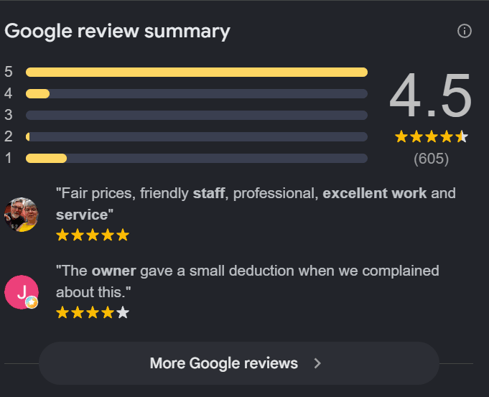
It breaks down once an AI assistant is the one doing the picking, since ranking well on Google no longer guarantees an AI assistant will recommend you. ChatGPT, Gemini, and Perplexity don't scan for the highest rating number on the page. They're instead trying to answer a question honestly, and a suspiciously flawless record works against that goal. A study from Northwestern University's Spiegel Research Center found that purchase likelihood peaks between 4.2 and 4.5 stars, then declines as a rating climbs toward a perfect five, because shoppers read total perfection as a "too good to be true" signal. AI models, trained on the same behavioral patterns, appear to have picked up on that trust based instinct.
How AI Assistants Evaluate Review Quality
A traditional search algorithm was based mostly on counting things: how many reviews, how high the average, how many keywords showed up in the text. (For a fuller picture on how reviews factor into search rankings, see Do Google Reviews Help SEO? The Honest Answer for Small Businesses). AI search reads reviews more like a skeptical person would, weighing a mix of signals against each other instead of adding up a single score.
That mix includes four signals:
- Volume: how many reviews exist
- Recency: how recently they were posted
- Specificity: whether the language is specific or generic
- Responsiveness: whether the business replies when something goes wrong
According to 2026 research on AI search visibility, businesses recommended by ChatGPT average 4.3 stars, not five, and freshness carries real weight: 74% of consumers only trust reviews from the last three months, and AI systems reflect that same preference. A business sitting on a stack of old five-star reviews with nothing recent looks, to a model weighing current reliability, less trustworthy than a business with a lower average and steady new activity. This is also the honest answer to "how many reviews for ChatGPT to recommend me" as there's no magic number, because it's the pattern across dozens or hundreds of reviews that a model weighs, not any single one.
The Sweet Spot: Star Rating, Volume, and Velocity Benchmarks
Put the research together and a rough target emerges of a star rating in the 4.2 to 4.7 range, backed by a meaningful volume of reviews, arriving at a steady pace rather than in one burst. This range is essentially an AI search star rating threshold, as it’s the range where the research consistently clusters, not a hard cutoff.
Volume matters because a handful of reviews doesn't give an AI model enough to work with. A business with only eight or nine reviews could have earned five stars from friends and family, and a model has no way to tell the difference. Estimates for where volume starts to look meaningful vary by source: NiceJob's research on home service businesses points to 150 or more, while Trustmary's broader cross-industry research puts the floor at 50, with 100 or more maximizing AI citation potential. The exact number shifts, but the direction doesn't, with more reviews evaluated over time being preferable to a small stack no matter how flattering.
Velocity is where the research agrees more sharply. NiceJob found that a business earning four to eight new reviews every month often reads as more trustworthy to search systems than one sitting on a much larger total that stopped growing months ago, and Trustmary puts a finer point on it: 50 fresh reviews can outweigh 200 stale ones from two years ago. A big number with no recent activity behind it tells an AI model that it might not be looking at the same business anymore.
None of this means a business should worry when a four-star review shows up next to a run of five-star ones. That's exactly the mix the research says builds trust. It also removes the pressure to chase a perfect record, since a slightly lower, more varied average paired with real volume tends to outperform a flawless one with nothing behind it.
Why Responding to Every Review Matters More Than You Think
A rating is one data point. A response is a second, and it's one a business fully controls.
When an owner replies to a review, positive or negative, it becomes fresh, first-party content that an AI model can read directly. It shows the business is active today, not just historically well-liked. It also gives a model context for a lower rating: a thoughtful response to a three-star complaint about a scheduling delay tells a very different story than the same review sitting there unanswered.
This is where automating the ask pays off twice. A steady, policy-compliant flow of review requests keeps velocity healthy without the spikes that can look manufactured, and a consistent reply habit turns every review, good or bad, into another signal that the business is paying attention. NiceJob's review request and response tools are built around exactly that combination: request reviews at a sustainable pace, and make sure none of them go unanswered.
For a broader look at how all of this fits together, see How Home Service Companies Get Found in AI Search.
The Bottom Line: Build a System, Not a Perfect Score
Review volume matters, and it has to keep building. Reaching that flow takes a system, like one where automatic requests go out after every completed job to bring in new reviews at a steady pace, without adding to your to-do list.
Don't fear the occasional negative review, either. A four-star rating, or a critical review with a thoughtful reply, makes your profile look more credible to customers and AI assistants alike. Real, recent, and varied feedback beats a flawless record with nothing substantive behind it.
FAQs
How many reviews does my business need to show up in ChatGPT and other AI search tools?
There's no universal number, but the research points to 50 as the minimum and 150 or more as the threshold where AI models have enough data to trust the average. Rather than chasing that count in one push, focus on steady monthly growth. A sudden spike in reviews can look just as manufactured to an AI system as it looks impressive to a person.
Does one bad review hurt me?
Generally not, and it can actually help. A mix of ratings reads as more credible than an unbroken string of fives, as long as the average stays healthy and any critical reviews get a thoughtful response.
How often should reviews come in?
Four to eight new reviews a month is a reasonable target for most home service businesses. A steady trickle beats a large batch followed by months of silence, since AI systems weigh recent activity heavily.
Where does your profile rank?
Want to see where your current review profile lands against these benchmarks?
Check Your Score