
10 years ago, "how do I get found online" meant one thing: rank on the first page of Google. That's no longer the whole question. A growing share of your customers are skipping the search bar entirely and asking an AI assistant to just tell them who to hire.
Nearly half of United States adults used an AI tool such as ChatGPT, Gemini, or Perplexity to find a local business in the past month, according to Yext's 2026 Consumer Search Behaviors Report. Among people who search for local services every day, that number climbs to 59%. For a plumber, electrician, roofer, or HVAC company, that means a real and growing slice of demand now runs through a conversation your business either shows up in or doesn't.
That conversation runs on a different set of rules than the ones that got you into Google's local pack, and most home service businesses haven't caught up yet.
Why Ranking Well on Google Doesn't Carry Over
Here's the uncomfortable part: doing well in traditional local search doesn't guarantee an AI tool will say your name out loud.
SOCi's 2026 Local Visibility Index, which analyzed data from nearly 350,000 business locations, found that businesses appear in Google's local three-pack 35.9% of the time on average, but only 1.2% get named by ChatGPT. Gemini recommended 11% of locations and Perplexity 7.4%. Across the retail sector specifically, SOCi found only about 45% overlap between the businesses that lead in traditional local search and the ones AI tools actually recommend.
The reason for this is structural, rather than some sort of ranking penalty. Google's local pack works from a list, so it can afford to show several options. An AI assistant is usually answering in a single sentence or two, so it has to be confident enough in a handful of businesses to name them by name and leave everyone else out. That confidence comes from a different mix of signals than the ones that get you into the map pack.
What AI Actually Weighs When Recommending a Business
Reviews matter more to AI recommendations than almost anything else, but volume, recency, and content all carry weight, not just your star average.
On volume, research on AI search visibility points to 50 reviews as a baseline for credibility, with 100 or more recent reviews doing the most to maximize the odds of being cited. Recency matters just as much as the total count. A profile with 150 reviews where the newest one is eight months old reads to an AI model, like a business that has gone quiet, according to a 2026 analysis of AI review signals. A steady trickle of 5 to 10 new reviews every month tends to outperform a large but stale pile.
Star rating matters less than owners assume. A flawless five-point-zero can even work against you. A 4.3 star average built on real, detailed, recent feedback beats a suspiciously perfect score, since AI systems are tuned to treat an unbroken run of 5-star reviews as a possible sign of manufactured or filtered feedback. What the AI is really parsing is the language inside your reviews. A review that says "great service, five stars" tells an AI almost nothing. One that describes what you fixed, how fast you arrived, and whether the price matched the quote gives the model specific, usable facts about your business, which is exactly the kind of plain and declarative information AI tools are built to extract and repeat.
This is also where responding to every review pays off twice. Your replies are indexable text, written in your own words, describing your services and how you handle problems. A business that answers every review, good or bad, is handing AI models a second stream of first-party content to learn from.
Pro Tip: The easiest way to hit these review thresholds is to make the ask automatic in terms of the text or email request that’s sent out the moment a job is marked complete or an invoice is paid, while the work is still fresh in the customer's mind. NiceJob triggers that request straight from your CRM, so it goes out without anyone having to remember.
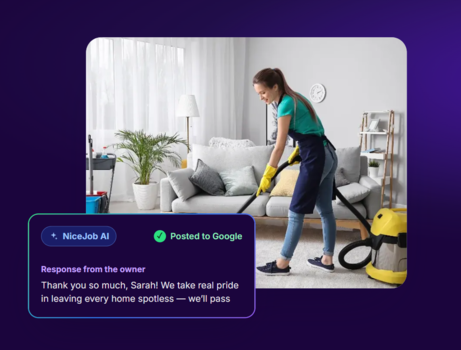
No More Missed Review Replies
NiceJob Pro drafts an AI-powered reply to every review, so responding to everything stops being a forgotten task.
Learn More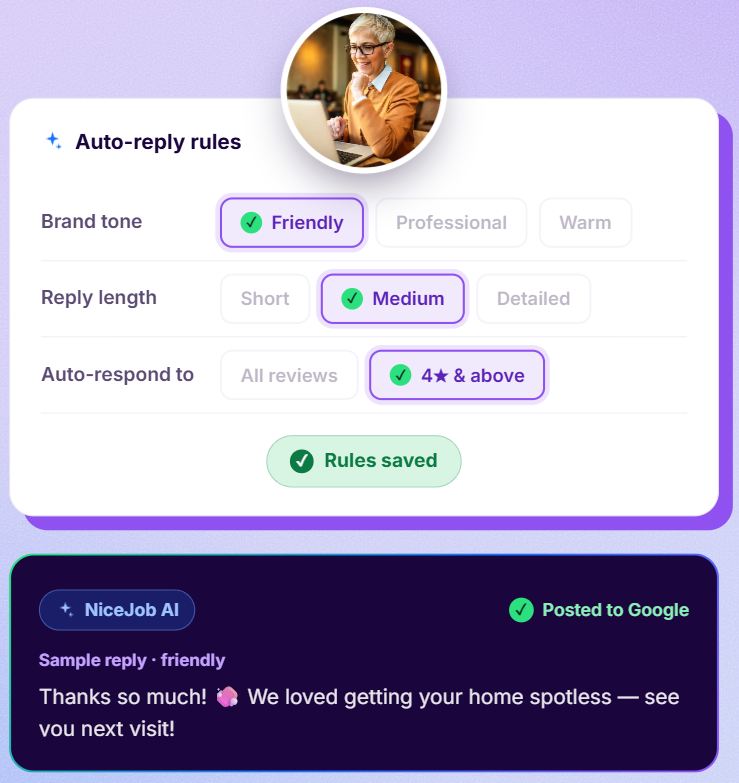
Your Business Information Has to Match, Character for Character
The name, address, and phone number of your business need to be identical everywhere an AI tool might pull data from:
- Your website
- Your Google Business Profile
- Apple Business Connect
- Bing Places
- Data aggregators (regardless of obscurity)
Even a small formatting mismatch like "Suite 100" on one platform and "Ste. 100" on another can lower an AI system's confidence in which listing is actually you. When your information conflicts across sources, the safest move for an AI model is often to leave you out of the answer rather than risk sending someone to the wrong address or number.
The fastest way to catch a mismatch is to search your own business name and city, then compare what comes back against your website, letter for letter. Most inconsistencies trace back to an old listing on a data aggregator that was never updated after a move or a phone number change, so that's the first place to check once a mismatch turns up.
Structured Data Helps, but It's Not the Shortcut It's Marketed As
You'll see plenty of claims online promising huge citation boosts from adding LocalBusiness or FAQPage schema markup to your website. However, there’s more to it than that. A large-scale test by Ahrefs, which tracked 1,885 pages, found that adding JSON-LD schema did not measurably increase AI citations on any platform it tested, despite pages that get cited by AI being about three times more likely to already have schema in place. The explanation is that businesses with clean structured data also tend to invest in the fundamentals that actually drive citations: strong content, technical SEO, and consistent information. Schema is a marker of a well-maintained site, not a lever that moves the needle on its own.
That doesn't mean skip it though; the point is to temper expectations and redirect focus. Machine-readable markup still helps search engines and some AI systems parse your services, service area, and pricing approach correctly, and it costs little to implement. Just don't expect it to substitute for the harder work of reviews, consistency, and content.
Plain, Factual Content Beats Marketing Copy
AI tools retrieve and synthesize live pages rather than following a fixed list, so a homepage that states your services, service area, and pricing approach in plain language gets picked up more easily than a page built around brand voice and calls to action. City-specific FAQ pages that answer the exact questions a customer would type, "how much does a water heater replacement cost in [your city]," "do you offer same-day emergency service," tend to feed directly into how these systems construct their answers.
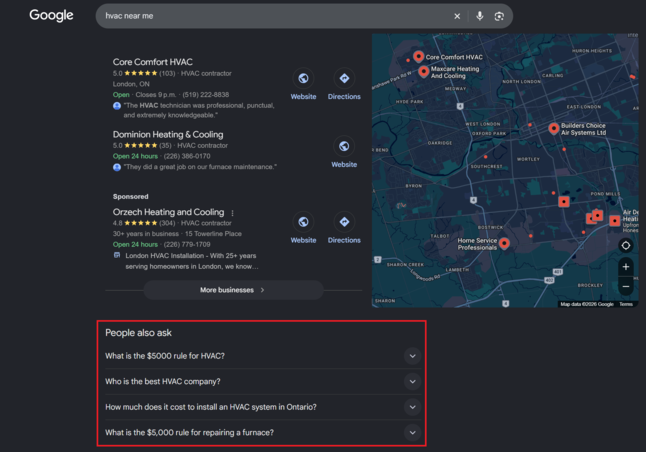
A simple way to find those questions is to check the "People also ask" box on Google for your own services, or look at what customers actually type into your contact form and chat widget. Those exact phrases, turned into FAQ headers with a direct one- or two-sentence answer underneath, are what gets lifted into an AI response.
A 90-Day Roadmap to AI Visibility
Getting found in AI search is more about following a sequence than a single step fix:
- Weeks one and two: audit your current AI visibility.
Ask ChatGPT, Gemini, and Google's AI Overviews the exact questions your customers would ask, and write down what each one says about your business and your competitors. Correct any factual errors at the source rather than trying to argue with the AI's answer directly, since these models pull from your own listings and site. - Weeks three through six: rebuild your content foundation.
Rewrite your homepage and service pages in plain, declarative language, build out city-specific FAQ content, and confirm your schema markup is in place, understanding it's foundational rather than transformative on its own. - Weeks seven through 12: build your review and reputation habit.
Put a review-request habit on autopilot, ideally within 24 hours of job completion, and respond to every review that comes in, good or bad. A tool like NiceJob makes this practical by connecting to your CRM in week seven, so a text and email request goes out automatically whenever a job is marked complete. Then use NiceJob Pro's AI-Replies to answer each new review in minutes instead of letting them pile up. By week 12, you should be on pace for the steady 5 to 10 new reviews a month mentioned earlier. - Ongoing: check in quarterly.
AI answers shift as these tools update their models and data sources, so a quarterly check-in on how your business shows up is worth the half hour it takes.
The businesses that show up in these answers a year from now won't be the ones that found a clever workaround. They'll be the ones with a steady flow of specific, recent reviews, information that matches everywhere it appears, and a website that tells AI systems exactly what it needs to know in language a model can lift and repeat with confidence.
Let AI Find You First
NiceJob handles the reviews and reputation work automatically, so the signals AI tools look for keep building on their own.
Start Free