•
Blog

If you run a home service business across more than one location, Google Business Profile (GBP) is one of the highest-leverage tools you have for local visibility. Each location gets its own presence in Google Search and Maps: its own reviews, its own ranking signals, its own shot at showing up when someone nearby searches for what you do.
The problem is that managing multiple profiles without a system gets messy fast. Information falls out of sync, reviews go unanswered, and locations that should be driving leads end up invisible. This guide covers how to set up, verify, and manage multiple GBP locations in 2026, including how the updated interface works, what mistakes to avoid, and how reviews fit into the picture for each location independently.
According to Google, businesses with complete GBP profiles are 2.7 times more likely to be considered trustworthy by customers. At one location, that matters. Across five, it compounds.
Why Each Location Needs Its Own GBP (and What Happens If You Skip It)
Google's local search results are geography-specific. When someone searches "HVAC repair near me" or "landscaping company in [city]," Google surfaces businesses with a verified, complete profile in that area. A single GBP listing tied to your headquarters does not extend coverage to your other service areas; those locations simply won't appear.
Each separate location also builds its own review history. A customer in one city leaving a review contributes to that location's rating, not a shared pool. This matters because local pack rankings are influenced by review volume and recency at the location level. A location with no reviews ranks below a competitor with 40, regardless of how strong your main profile is.
There's also a practical trust issue. Customers searching for a local business want to see an address, hours, and photos that match where they actually are. A profile that lists a different city, or no address at all, loses that customer before they ever make contact.
For home service businesses specifically, where trust and proximity drive almost every booking decision, having a complete, verified profile for each location is table stakes.
How to Set Up Multiple GBP Locations Step by Step (2026 Interface)
Google updated the GBP Manager interface significantly in 2025. The steps below reflect how it works now. If you haven't set up your first profile yet, start with this guide for setting up and optimizing a Google Business Profile for local SEO before adding additional locations.
Creating Your First Additional Location
If you already have one GBP set up, adding a second location starts from your existing dashboard. Search for your business name on Google, and you'll see an owner panel similar to the one below.
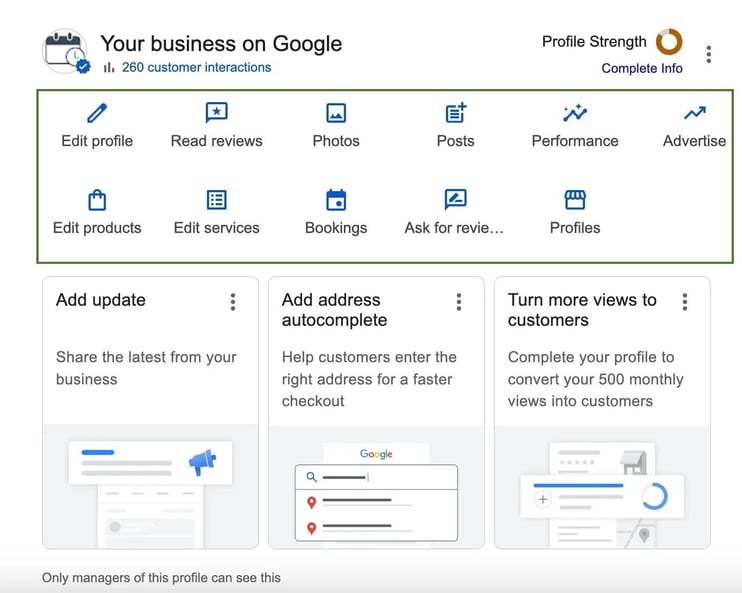
From here, click "Profiles" in the dashboard panel to access your Business Profile Manager. To add a new location:
- In Business Profile Manager, click "Add profile" or "Add business"
- Enter the business name for the new location
- Fill in the address, phone number, website URL, hours of operation, and business category
- Click "Continue" and follow the prompts to begin verification
Repeat this for each location you want to add. Each one will need to go through verification before it appears publicly.
Using Business Groups to Manage at Scale
If you're managing between two and nine locations, Business Groups let you organize them under one account so you can switch between profiles, delegate access, and monitor performance without logging in and out repeatedly.
To create a Business Group:
- In Business Profile Manager, click the menu at the top left
- Select "Create group"
- Name the group (your business name works well)
- Add your existing locations to the group
- Assign managers to specific locations if needed
Business Groups also let you set location-specific managers, which is useful if you have an office manager at each location who handles day-to-day updates and review responses without having full admin access to every profile.
Bulk Import for 10+ Locations
If you're managing ten or more locations, Google offers bulk verification, which is faster than verifying each profile individually. To use it:
- In Business Profile Manager, click "Import businesses"
- Download Google's bulk upload spreadsheet template
- Fill in the required fields for each location: name, address, phone, website, category, hours
- Upload the completed spreadsheet
- Submit a bulk verification request
Google verifies bulk submissions by email, video, or postcard depending on the business type. Processing typically takes a few days to a few weeks.
How to Verify Multiple Locations Quickly
Verification is what makes a GBP listing appear publicly on Google Search and Maps. Without it, the profile exists in your account but is invisible to customers.
For businesses with fewer than ten locations, each profile is verified individually. Google's current verification options include video verification (most common), phone or email, and postcard by mail. Video verification, where you record a short walkthrough showing your storefront, signage, and interior, has become the default for most home service businesses and is usually the fastest option.
A few things that slow down verification and how to avoid them: make sure the business name on your profile matches your signage exactly; use a local phone number rather than a call center number; and ensure the address you enter is accurate down to the suite or unit number. Discrepancies between your profile and what Google can see elsewhere online, on your website or in directory listings, can trigger additional review steps.
For bulk verification at ten-plus locations, see the bulk import section above. Once you submit the request, a Google representative typically follows up within a few business days.
Managing Multiple Locations Without Losing Your Mind
Centralized Dashboard Tips
Business Profile Manager is your central hub. From there you can see all locations at once, filter by status (verified, unverified, suspended), and identify which profiles need attention. Get into the habit of reviewing all locations at least once a week, checking for suggested edits from Google or users, new reviews that need responses, and any profile suspensions.
One underused feature: the Performance tab at the location level shows how many searches, map views, and direction requests each location is generating. If one location is significantly underperforming others, it's usually a sign that the profile is incomplete or the category is wrong.
Setting Up Location-Specific Managers
You don't have to manage every profile yourself. In Business Profile Manager, you can assign three levels of access: owner, manager, and site manager. Owners have full control including the ability to remove the business. Managers can edit the profile and respond to reviews. Site managers have limited access and can update hours and photos but can't make structural changes.
For multi-location home service businesses, a practical setup is one owner account at the company level and a manager assigned at each location, someone local who can respond to reviews quickly and keep hours accurate during holidays or service changes.
Keeping NAP Consistent Across Locations
NAP stands for name, address, and phone number. Google cross-references your GBP data against other directories, your website, and structured data across the web. When the information conflicts, say a different phone number on a directory listing or a misspelled business name somewhere, it weakens your local ranking signals.
For multi-location businesses, NAP consistency is harder to maintain because there are more profiles to track and more places for discrepancies to appear. A simple approach: maintain a master spreadsheet with the exact NAP format for each location, and use it as the reference any time you're updating a profile or listing anywhere. The format that's in your GBP is the format everything else should match.
The Number One Thing Multi-Location Home Service Businesses Get Wrong
It's duplicate content across profiles. When a business adds a second or third location, the easiest path is to copy the description, services, and posts from the first profile and paste them across. It's faster in the short term and feels harmless. It isn't.
Google uses the content of your GBP profiles, including descriptions, service listings, posts, and Q&A, as signals for what each location offers and where it's relevant. When every profile says the exact same thing, Google has less to differentiate them, which can suppress all of them in favor of competitors with location-specific content.
The fix is straightforward. Write a unique business description for each location that references the specific area it serves. Customize your service listings if the locations offer slightly different services or serve different types of jobs. Post location-specific updates: a team photo from that branch, a job completed in that neighborhood, a note about seasonal hours for that office. It doesn't have to be completely different content, but it needs to be specific enough that Google can tell these are distinct local businesses, not carbon copies.
How Reviews Work Across Multiple Locations (and How to Automate Them)
Reviews on Google are tied to individual profiles. A customer who leaves a review for your downtown location is contributing to that location's rating and ranking, not a company-wide average. This means each location needs its own review engine running independently.
The practical challenge for multi-location home service businesses is that review collection tends to be inconsistent. The main location might have 80 reviews because someone set up a process early. A newer location has 12. A third has 4. That gap matters in local search, and it compounds over time if you don't address it.
The most effective approach is to automate review requests at the job level so every completed job triggers a request regardless of which location handled it, and that request links to the correct location's GBP profile. Manual processes break down as you scale: someone forgets, the wrong link gets sent, or requests only go out when a manager remembers to do it.
NiceJob handles this automatically per location. When a job closes, NiceJob sends a review request linked to the right profile, follows up if there's no response, and routes the review to Google. Each location builds its own review velocity without requiring anyone to manage it manually. For home service businesses adding locations, this is one of the cleaner ways to make sure a new branch isn't starting from zero on reviews six months after it opens.
For more on building a review strategy that works at scale, see How to Get More Google Reviews for Home Service Businesses and Top Local SEO Factors: Boost Visibility, Rankings, and Reviews.
How GBP Connects to AI Overviews in 2026
Google's AI Overviews are the AI-generated summaries that now appear above organic results for many local searches, and they pull heavily from GBP data. When someone searches "best HVAC company in [city]" or "landscaping services near me," Google's AI is synthesizing information from GBP profiles, reviews, and local web content to generate its answer.
What this means practically: a complete, accurate, regularly updated GBP profile increases the likelihood that your business gets cited in an AI Overview for relevant searches. Incomplete profiles, profiles with outdated hours, or profiles with no recent reviews are less likely to be surfaced because the AI has less high-confidence information to work with.
A few things that improve your chances of appearing in AI Overviews for local searches: keep your business category accurate and specific; add detailed service listings with clear descriptions; maintain a steady stream of recent reviews with substantive text (not just star ratings); and post regular updates. The AI is looking for signals that a business is active, relevant, and trusted locally, which is also what good GBP management produces anyway.
For context on how local SEO and reputation signals interact, see What Is Local SEO and Why It Matters for Your Business.
Franchise and multi-location businesses have an additional opportunity here. Each location that's properly set up and actively managed is another potential citation point in AI answers for that area. A five-location business with complete, active profiles in five cities has five times the surface area in local AI search. See Best Practices for a Winning Franchise Customer Review Strategy for more on managing reputation at scale.
FAQ
Can I have two GBPs at the same address?
Yes, if two legitimately separate businesses operate from the same address. Google allows this as long as each business has a distinct name, phone number, and category. This is common for businesses that share a building, such as a plumbing company and an HVAC company under the same owner. What Google does not allow is creating two profiles for the same business at the same address to try to occupy more local pack positions. That violates GBP policy and can result in both listings being suspended.
Do I need a separate Google account for each location?
No. One Google account can manage multiple GBP profiles through Business Profile Manager. You can also grant manager access to other Google accounts for specific locations without giving them access to the full account. Most multi-location businesses run everything through a single owner account and assign location-level managers as needed.
How do I add a second location without losing my reviews?
Reviews are tied to individual GBP profiles, not to your Google account. Adding a new location creates a new profile with its own review count starting at zero and has no effect on the reviews already on your existing profile. The thing to avoid is creating a duplicate of an existing location by accident, which can cause Google to merge profiles or flag one for removal. As long as you're adding a genuinely new location with a different address, your existing reviews are safe.
How many locations can you add to one Google Business Profile account?
There's no published limit on how many locations you can manage under one Google account. The practical distinction is at ten locations: below that, each profile requires individual verification. At ten or more, you can request bulk verification, which lets Google process all locations at once rather than one at a time. Google verifies locations by phone, email, video, or postcard depending on the business type.
How Top-Rated Multi-Location Businesses Use Reviews to Get More Customers
Getting GBP set up correctly across multiple locations is the foundation. What separates the businesses that consistently rank well is what happens after: reviews coming in at every location, responses going out promptly, and each profile staying active with current information.
NiceJob's case studies library has real examples from home service businesses that have built that system and grown their customer base as a result.
If you're ready to automate the review side of it, NiceJob connects to your GBP profiles per location and handles review requests, follow-ups, and distribution automatically.
See how NiceJob helps every location get more reviews automatically
14-day free trial. No credit card required.
Start Free