

Yes. Google reviews are a confirmed local ranking factor. They influence where your business appears in Google's local pack, affect click-through rates in search results, and contribute to Google's "prominence" signal.
Here's what the research shows.
The Short Answer, with Evidence
Four findings worth knowing before anything else:
- Review signals account for 16 to 20% of local pack ranking weight, according to Whitespark's 2026 Local Search Ranking Factors report, which surveys roughly 50 local SEO experts annually. That share has been rising year over year.
- Google confirms reviews factor into local ranking through "prominence": prominence is its measure of how well-known and trusted a business is across the web and it’s one of the three core signals Google uses to rank businesses in local search, alongside relevance and proximity. More genuine, recent reviews strengthen that signal.
- Review velocity matters more than total count. According to case study research from Sterling Sky, consistent monthly reviews carry more ranking weight than a large, stagnant total, and a separate recency study found that listings can see ranking drops if new reviews stop coming in for as little as three weeks.
- 73% of consumers only trust reviews from the last 30 days. Recency affects both rankings and whether a customer acts on what they see.
How Google Reviews Affect Local SEO Specifically
This is where most articles get fuzzy, so it's worth being precise: reviews affect local SEO and organic SEO differently.
Local pack rankings (Google Maps, the three-pack): This is where reviews have direct, documented influence. Review quantity, velocity, recency, and sentiment all feed into where your business lands in the map pack. Appearing in the local three-pack generates roughly 126% more traffic and 93% more actions than positions four through ten. That's the gap reviews can move you into or out of.
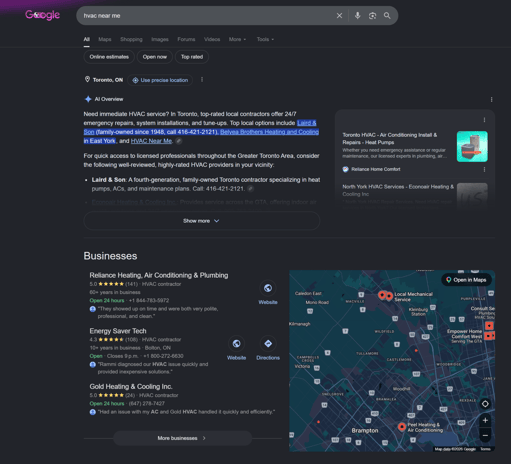
Organic blue-link rankings: The effect here is indirect. Reviews on your Google Business Profile don't push your website up the organic results on their own. What they do is improve click-through rate when you do appear. A higher star rating displayed in search results makes people more likely to click, and that behavioral signal feeds back into how Google evaluates your relevance.
If your business depends on local customers finding you through search, the local pack is the one that matters. That's where reviews have real, measurable weight.
Does Your Star Rating Affect Rankings?
Yes, but not in the way most people think.
The 4.0 threshold is the practical floor. 68% of consumers only use businesses rated four stars or higher, which means falling below 4.0 affects conversion before it affects ranking. Google also uses rating as a prominence signal, so a pattern of low scores can suppress local pack visibility.
Above 4.0, the difference between 4.3 and 4.8 matters less for rankings than volume and velocity do. A business with 80 reviews averaging 4.4 stars will typically outrank one with 15 reviews averaging 4.9. Getting more reviews consistently beats optimizing for a perfect score.
One thing to understand: a 2025 case study found businesses saw a ranking boost when they hit 10 reviews, with gains tapering off beyond that point in terms of step-change improvement. The real advantage comes from steady new reviews over time, not a burst followed by silence.
Does Responding to Reviews Help SEO?
Yes, and Google has said so explicitly. Google has confirmed that managing and responding to reviews impacts local search visibility, with response timeliness and responding to both positive and negative reviews both playing a role.
The mechanism isn't mysterious. When you respond consistently, you signal to Google that the business profile is actively managed, which is a legitimacy signal. Businesses that respond to 80%or more of reviews see a measurable ranking boost..
There's a secondary effect worth knowing: keywords that naturally appear in your responses such as your service type, your city, specific job details etc. add relevant text to your Business Profile that Google indexes. This isn't a reason to keyword-stuff responses, but it does mean thoughtful and specific replies do more work than generic ones.
For templates on how to respond, see our guides on responding to positive reviews and responding to negative reviews.
Does Review Recency Matter?
It matters a lot. 73%of consumers only trust reviews from the last 30 days, and 83% say recency is essential for trust (Sixth City Marketing / Trustmary). Google's algorithm reflects this as a steady flow of recent reviews outweighs a large but stagnant pool.
This is the part most home service businesses get wrong. They run a push to collect reviews, land at 40 or 50, then go quiet for six months. A competitor who collects three to four reviews every month will close that gap and eventually pass them, even starting from a lower total.
Consistent review velocity is a compounding advantage. It also means your profile always looks active to both Google and prospective customers reading your reviews before they call.
What This Means for Your Business: A Practical Checklist
- Get above 10 reviews as fast as possible. That's the first meaningful threshold for local ranking. If you're under 10, this is the priority.
- Ask after every completed job. Review requests sent within 24 hours of job completion convert significantly better than delayed follow-ups.
- Respond to every review, positive and negative. Aim for a response within three days. This is a confirmed ranking factor and a consumer expectation.
- Don't stop. Steady volume beats any single burst. Two to four reviews per month, consistently, compounds over time in a way that a once-a-year push doesn't.
- Watch your rating floor. If you're below 4.0, addressing the source of negative reviews is more urgent than collecting new ones.
- Check your competitors' review counts for your primary keyword and location. If they have five times more reviews than you do, that's the gap. Reviews are one of the few local ranking factors you can actively influence.
For a broader look at how your review profile fits into your search presence, our guide to SEO reputation management is a good source.
Frequently Asked Questions
Do Google reviews affect organic (non-local) search rankings?
Not directly. Reviews influence local pack rankings: the map results that appear for searches with local intent. For standard organic blue-link results, the effect is indirect: higher star ratings improve click-through rates when your website appears in results, and that behavioral signal can influence how Google evaluates your page over time. If you're targeting local customers, the local pack is where reviews have the most impact.
How many Google reviews do I need?
Ten is the first meaningful ranking threshold based on available research. Beyond that, the goal is consistent velocity or steady new reviews over time, rather than hitting a specific number. For competitive markets, compare your count to the businesses ranking above you for your primary search term and close the gap progressively.
How do I get more Google reviews?
The most effective approach is timing and consistency. Review requests sent within 24 hours of job completion convert significantly better than delayed follow-ups, and SMS outperforms email for response rate in most home service contexts. The goal is making the ask automatic after every job, not just memorable ones.
In practice, that means building the request into your post-job workflow: a quick text with a direct link to your Google review page, sent while the experience is fresh. Manual follow-up works when you're small, but most businesses find that volume becomes unsustainable without automating the process. For a step-by-step breakdown of what that looks like, see our review generation guide.
NiceJob handles this automatically, sending review requests via SMS and email after each completed job so your velocity stays consistent without adding anything to your team's plate.
Do negative reviews hurt SEO?
A pattern of low ratings can suppress local pack visibility and will affect conversion before it affects ranking. Individual negative reviews, when responded to professionally, have limited ranking impact. The bigger risk is a low overall score or a long stretch with no new reviews, which makes older negative ones more visible. For guidance on handling them, check out how to remove a Google review and how to respond to negative reviews.
Does the text inside reviews matter for SEO?
Yes. Keywords that appear naturally in review text including service names, location, specific job details, add relevant content to your Business Profile that Google indexes. You can't control what customers write, but you can prompt them toward specific details by asking about the job type or location in your review request. Don't ask customers to include specific keywords, and instead just ask them to be specific about their experience.
Does review velocity matter more than total review count?
For sustained local ranking, yes. Consistent monthly review collection signals an active, trusted business. A large but stagnant review total will be outcompeted over time by a business with fewer reviews but steady momentum.
Don’t let your review count work against you
NiceJob automates review requests via SMS and email so your review count and recency never work against you.
Start Free
.png)


.png)
-1.png)