
Last Updated: May 2026
Reputation marketing is the practice of actively building your online reputation—primarily through customer reviews—and then using it as a marketing asset to win new customers.
Most business owners already understand word-of-mouth. A happy customer tells a friend, and that friend becomes a lead. It works. But it’s unpredictable. You can’t control when or how often it happens.
Reputation marketing changes that. Instead of waiting for customers to talk about your business or write a review online, you ask for feedback and make it visible. Reviews, testimonials, awards, and other proof show up where customers are already searching—on Google, your website, and social media—before they ever contact you.
A plumber with 200 five-star Google reviews has strong credibility. But if his reviews are in one place, they only help when people find them. When those same reviews show up in multiple places—on his website, on social media, on Google, and in ads—they influence every person who comes across his business.
That’s the core idea: turn everyday customer experiences into proof people can see, trust, and act on.
Reputation Marketing vs. Reputation Management: What's the Difference?
You’ve probably heard of reputation management. It’s what most businesses do—monitor for bad reviews, respond to complaints, and do damage control when something goes wrong. It’s defensive work, and it’s necessary.
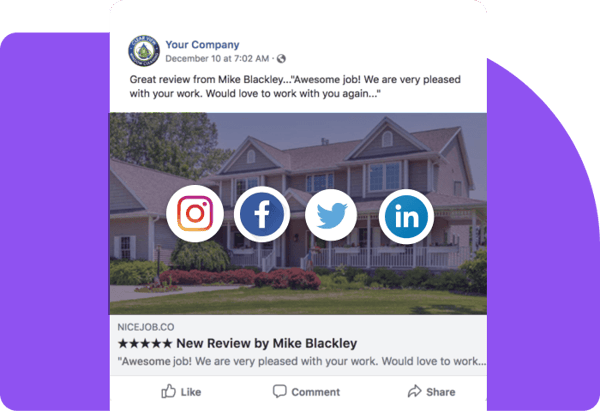
Reputation marketing puts your business on the offensive. Instead of reacting, you’re actively building your reputation. You collect great reviews and then put them in front of potential customers. That can be a before-and-after picture on social media, a community award highlighted on your website or even a customer testimonial in your ads. With these steps, you’re not waiting to be found. You’re making sure the right customers see your best proof at every touchpoint.
Think about how customers actually choose between businesses. A landscaping company with a high rating, but outdated reviews and no activity looks less trustworthy than one with a slightly lower rating, but steady new reviews, responses, and photos across its website, business profile, and social media. The second business is not just managing their reputation—they're using it to win more customers.
Most businesses stop at management, but the opportunity—and the growth—is in what comes next.
Why Reputation Marketing Matters More in 2026
Search has changed. Customer behavior has changed—and businesses that understand this are pulling ahead of those that don’t. Most business owners understand how a poor online reputation can significantly impact your bottom line. But let's take a deeper dive into why your reputation matters more than ever in 2026.
Traditional Search Still Matters—and Reviews Drive It
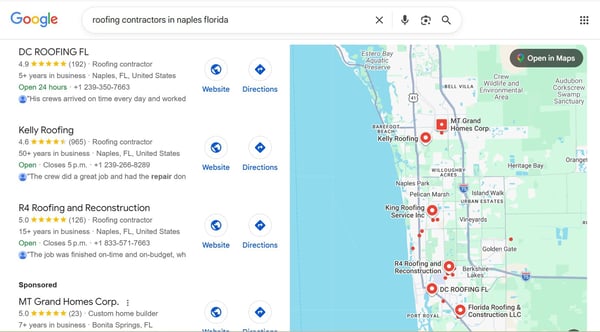
About 96% of customers look for local businesses on Google. When someone searches for “HVAC company near me,” they’re actively looking for a business they can trust right now.
That decision often starts with the local map pack—the top three businesses Google shows in local search. Your review count, your Google listing, and how recent your reviews are directly affect where you rank in search results and whether a customer clicks on you.
Businesses with a solid rating and a steady stream of recent reviews outrank competitors—even ones with stronger websites and more domain authority. Review volume tells Google—and customers—that your business is active.
Recency matters too. Around 73% of customers don’t trust reviews older than a month. New, consistent reviews tell customers your business is still worth calling.
AI Search is Changing Where Customers Find You
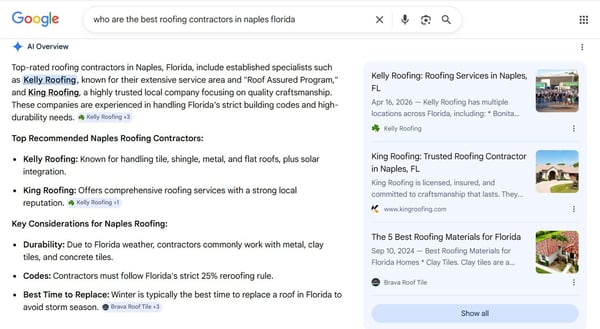
Google’s AI Overviews is shifting how customers get answers—not just how search results look. Instead of just showing a list of links, Google now generates an answer at the top of the page—including direct business recommendations.
When someone searches “who are the best plumbers near me,” Google’s AI recommends businesses based on trust signals it can read and verify. Reviews are one of the strongest because they show real customer experiences across many jobs.
The businesses that show up in AI-generated answers have the same pattern: high review volume, recent activity (within the last 30 to 90 days), strong ratings, and consistent details—number, address, phone number—across Google, Facebook, and other platforms.
AI search also narrows the field. Instead of comparing the top business listings on the first page, customers may only see a handful of recommendations. For businesses with a strong reputation, that’s an advantage—your signals do more of the talking.
And it’s not just Google’s AI Overview. Tools like ChatGPT and Gemini now recommend local service providers when users ask questions like “who’s the best landscaper in Austin?” They pull from review data, business ratings, and online reputation signals—not just websites. A strong reputation now earns you visibility in both places: traditional search and AI-generated answers.
In 2026, reputation marketing isn’t only a strategy for traditional search—it’s an AI visibility strategy too.
How Reputation Marketing Works in Practice
Once set up, using a reputation marketing system should be simple and easy to use. Here’s what this looks like in a real business:
-
A job gets completed. A professional window cleaner finishes the job at a residential home. He takes a photo and marks the job as complete in his field management software.
-
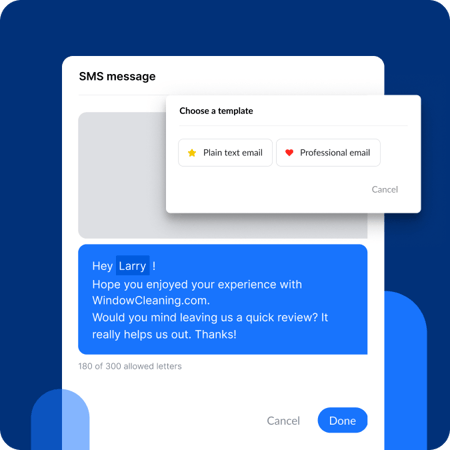
A request goes out. The review automation software, connected to a CRM, automatically triggers the review invitation once the job is marked complete. The customer immediately receives a text that thanks them and asks for feedback, with a direct link to leave a review.
-
A follow-up closes the loop. The customer is more than satisfied with their experience. But forgets to leave a review. Two days later, they receive a follow-up. This time, the customer leaves a review right away.
-
The review becomes visible. The review appears on your Google listing. The embedded review widget on the website updates to display it. The business shares the same review with before-and-after photos on social media. With automated social proof tools, this happens automatically and compounds your visibility.
-
The process repeats. Each completed job creates another review. Each review adds new proof. Over time, the business builds a good volume of steady feedback, visible results, and active online profiles.
-
Now, fast forward. A homeowner searches for “window cleaning near me.” She sees a window cleaning business with a high rating and recent reviews. She visits the website and sees real reviews, before-and-after photos, and that the business won home service awards. It’s a business that clearly looks trustworthy and active.
The choice to call is straightforward, and this is how reputation marketing works. Every job creates an opportunity for feedback, and that feedback turns into tangible results. It all comes together to build trust—and prove why your business is the right choice before customers pick up the phone.
How to Build a Reputation Marketing Strategy (Step-by-Step)
A reputation marketing strategy is more than just building habits. It’s about setting up a system that continues long after the job is done. These steps show how to build that system, so your reviews don’t just sit idle—they work to stay visible and bring in more customers.
1. Claim and Optimize Your Google Business Profile
This is the home base for your reputation. It’s where most customers form their first impression. Customers are 2.7 times more likely to consider a business reputable if they find a complete Business Profile.
Complete every field:
-
Business details—number, address, phone number (NAP)
-
Business hours
-
A clear description of your business
A complete profile sends the right signal to both customers and Google. If this isn't done, start here.
Most businesses stop there, but you can do more to optimize your profile. Post real photos from recent jobs. Add more details about your business—the area you service, which core service category your business falls under, and if you offer any additional services. These details accurately reflect your business to customers. An active business profile tells both Google and potential customers that your business is open and running.
2. Set Up a Review Collection System
Review collection starts with a system that asks for reviews after every job:
-
Send a review request via SMS or email within 24 hours of completing a job, while the experience is still top-of-mind.
-
Follow up if they don’t respond, as it increases the likelihood of customers leaving a review.
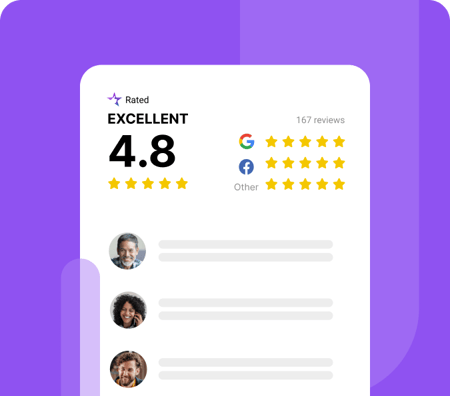
Consistency and timing matter the most. Set up a system that sends review requests automatically and follows up, if needed. NiceJob does this on autopilot and has over 1,000 partner integrations, so a review request goes out automatically after a job is marked done.
👉Not ready to get started with NiceJob? Use our Free Google Link Generator so that you can manually ask for reviews on your invoices or other customer communications.
3. Respond to Every Review
Google uses your responses as a local SEO ranking signal. But more importantly, customers read responses before deciding to call. A business that engages with its reviews looks like one that values its customers—and that alone can be the deciding factor.
Here are some tips for replying to reviews:
-
Keep your response simple and specific.
-
Use the customer’s name when you thank them for a positive review.
-
For challenging reviews, address the concerns directly.
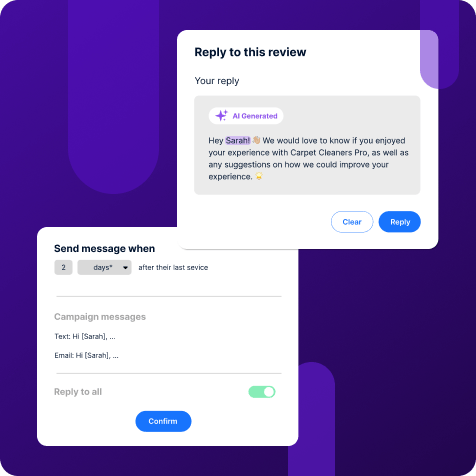
Over half of customers expect responses to their reviews, especially for tough ones. But most businesses don’t reply to customer reviews. Stay ahead of the curve by automating your review responses, so no review slips through the cracks.
4. Embed Reviews on Your Website
Your website helps customers make decisions. When a potential customer is comparing options, reviews can be what tips the decision, so they need to be visible on your website. Adding review widgets does the job.
There are different review widgets you can add to your website. Having a microsite that hosts your reviews and updates automatically leaves a stronger impression. It carries far more credibility than handpicked testimonials—customers know the difference.
%20(1).webp?width=450&height=450&name=stories%20widget%20(2)%20(1).webp)
5. Share Reviews on Social Media
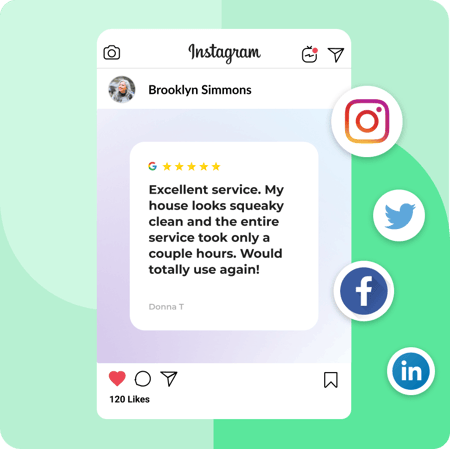
Your best reviews also make great social content, and they’re often ready-to-share. You promote your business with real results and customer experiences—that often resonates more than a sales pitch online.
A post from a roofing cleaning company with a before-and-after photo and a review quote that says “Our new roof got done in a day!” is more persuasive than an ad you could write yourself. NiceJob’s Social Sharing tool shares new reviews to your connected social accounts—automatically, so your feed stays active without added effort.
6. Monitor and Measure
Track your performance to understand if your system is working—and where to push harder.
Keep an eye on these three metrics:
-
Average star rating
-
Review velocity (how many new reviews per month)
-
Review distribution (how reviews are shared across platforms)
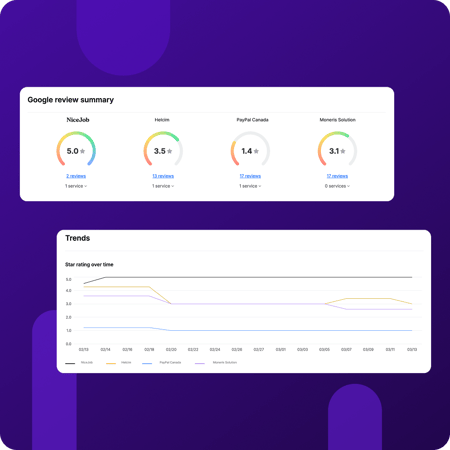
If new reviews slow down, your online visibility often follows. These signals can show you where to adjust and where to stay consistent.
What to Look For in a Reputation Marketing Tool
The right tool removes friction from every step of the process.
Here’s what matters when you’re evaluating options:
-
Automates review requests via SMS or email, automatically triggered by job completion
-
Integrates with your field service management software or CRM
-
Embeds review widgets with live feeds on your website
-
Shares reviews to your social media accounts without extra steps
-
Lets you monitor and respond to reviews from one dashboard
-
Provides clear reporting on review volume, average rating, and overall performance
Bonus points for a tool that takes it to the next level. Not to shamelessly plug NiceJob, but we’re going to do it anyway. Once you’ve mastered reviews, our Pro features can help with rebookings, referrals, and more.
NiceJob is purpose-built for home service businesses. It connects to over 1,000 systems—including Jobber, Service Titan, QuickBooks, and more—so review collection starts from day one. No manual asks. No switching between tools.
Reputation marketing isn’t a trend. It’s a system. Your customers are already forming opinions after every job. Reputation marketing makes sure those opinions get captured, amplified, and put in front of the right people—turning every completed job into a reason for the next customer to choose you.
👉 Learn more about what you can do with a NiceJob Pro tech stack.
Frequently Asked Questions
What is an example of reputation marketing?
A roofing contractor completes a job, and NiceJob’s automation software automatically sends the homeowner a review request by text. The homeowner leaves a 5-star Google review. Then, NiceJob’s Social Sharing tool automatically posts that review to the contractor's Facebook page and adds it to the Stories widget on their website. Six months later, a neighbour sees those reviews and calls. That's reputation marketing.
Is reputation marketing the same as word-of-mouth?
Similar concept, different scale. Word-of-mouth is organic and unpredictable—a happy customer might tell one friend, or no one. Reputation marketing makes it systematic: you ask for it, amplify it across every channel, and track it. The result is the same trust, but far more reach.
How do you do reputation marketing?
Start with three things: set up an automated review request system so every completed job triggers an ask, optimize your Google Business Profile so those reviews are visible in search, and embed your reviews on your website so visitors see them immediately. NiceJob handles all three automatically.
What's the difference between reputation marketing and reputation management?
Reputation management is reactive—responding to reviews and handling complaints. Reputation marketing is proactive—systematically building a positive reputation and using it to attract new customers. You need both, but reputation marketing drives growth.
Ready to put your reputation to work?
NiceJob automates the entire process—review requests, social sharing, website widgets, and response tracking—so your reputation grows on autopilot while you focus on the job.
See Pricing
.jpg)


.jpg)